
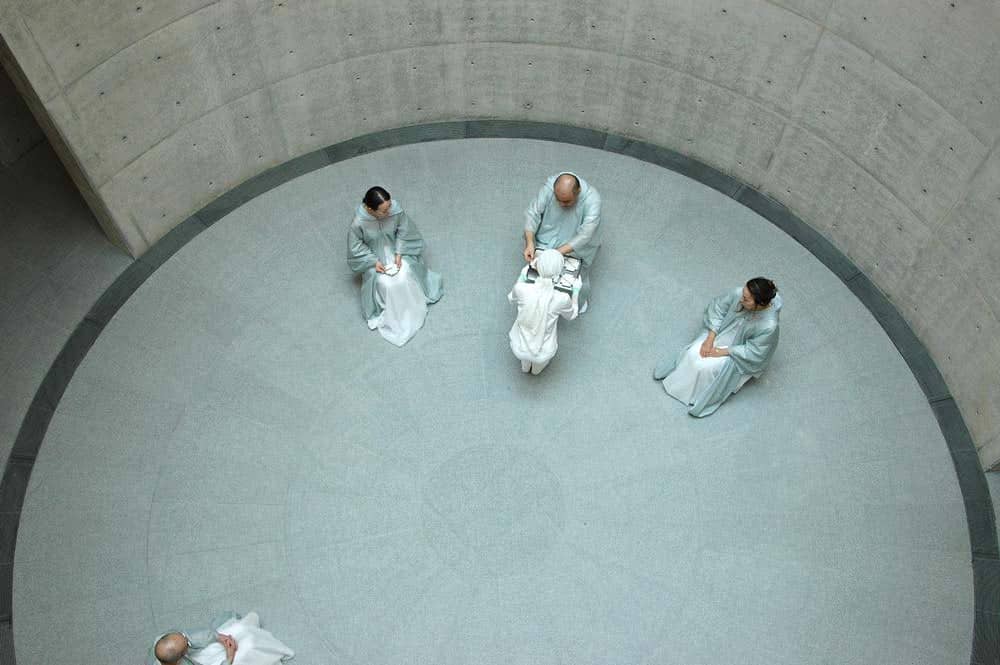
Absence of the teamaster performed and filmed at Ishikawa Nishida Kitaro Museum of Philosophy in Japan, is a collaborative research project between Austrian artist Margret Wibmer and Japanese curator and artist Akane Nakamori. This transcultural collaboration explores the value of traditions and rituals in contemporary culture, the influence of globalisation on perception of culture as well as the relation between ancient traditions and gender roles.
In ‘Absence of the tea master’ the tea master was replaced by contemporary dancer Kiyomi Yamashita. This radical change of setting was further supported by the outer worldly musical composition of Kanazawa based composer Minowa Norihiro who not only designed a soundscape but also a sound system for this particular architectural space. Choreography, sound, design of the garments and other props were inspired by the architecture of the museum, designed by Tadao Ando. All invited participants are experts in the field of contemporary art and/or preservation of cultural heritage, among them Tokyo based tea master Fuyuko Kobori. This ‘0’ event was followed by two consecutive performances in Düsseldorf and Amsterdam, developed for the European context. The garments were designed and hand-crafted by Margret Wibmer in collaboration with Kanazawa Bunka Fashion College’s students and tutors.
Transition from arrival to departure
May 24th 2013 – 7 p.m. A participatory art event based on the concept of the traditional Japanese tea ceremony and reinterpreted for the contemporary context.
Weltkunstzimmer – Hans Peter Zimmer Foundation, Düsseldorf / Germany. Sponsored by: Austrian Federal Ministry for Education, the Arts and Culture (AT), Land Tirol (AT), Mondriaan Foundation (NL), Komatsu Seiren Co., Ltd. (JP)
It was a particular honour to collaborate on both events with tea ceremony master Fuyuko Kobori, who, in November 2025, followed in her father’s footsteps to become the 17th generation tea master. She continues the lineage of Kobori Enshu (1579–1647), one of the foundational figures of the Japanese tea ceremony, who was also renowned as a garden architect and poet.

Introduction and project description:
Absence of the teamaster which took place on February 21s at the Nishida Kitaro Museum of Philosophy in Japan, a museum designed by famous architect Tadao Ando, is dedicated to Nishida Kitaro (1870 – 1945), the first Japanese philosopher who was aiming to open a uniquely Japanese path in its confrontation with Western philosophy, describing a world in transition with the rise of modernity in the West and its subsequent globalisation. The performance in Japan, published as a video work, was an attempt to access some aspects of this old ritual through re-interpretation and to develop a possible form for the contemporary global and the Western context. That this second event is taking place in Germany was a conscious choice as there has been close relations between Nishida Kitaro and the Kyoto School with German philosophers.
When Japan opened itself to international trade in 1854 and wanted to become a modern industrial and military power in its own right, the Japanese government sent intellectuals to Europe and the United States to study what was needed for modernization, which included the study of Western Society and Western thought. Most Japanese philosophers turned towards Germany for their inspiration. How to negotiate the differences between traditional Asian and modern Western values became a major concern among Japanese philosophers in the first half of the Twentieth Century. With our project we aim to draw attention to the above mentioned and to cultural relations between East and West in the past and today.
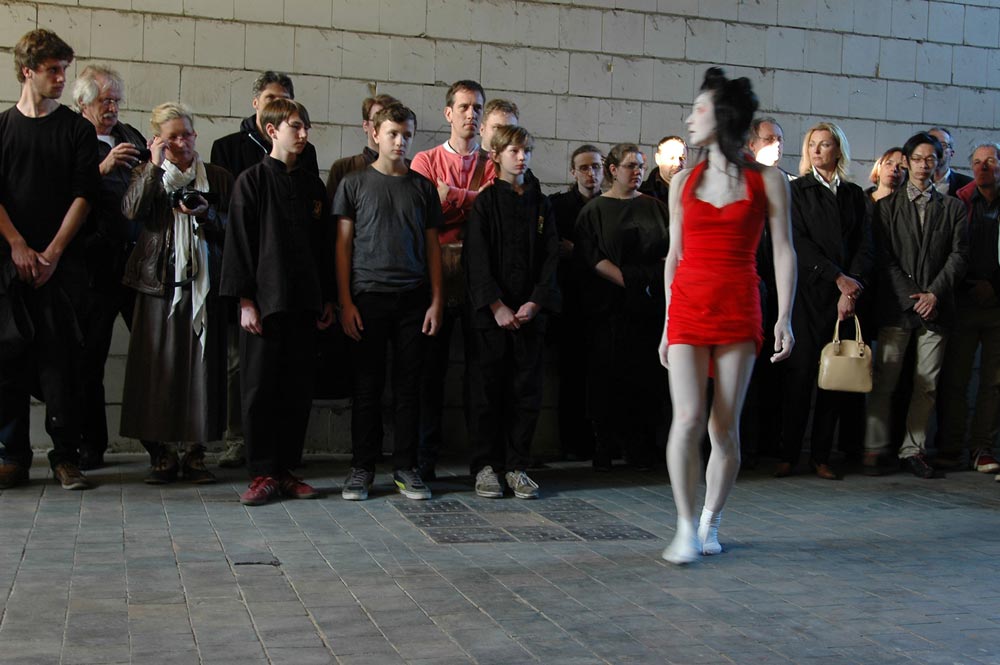
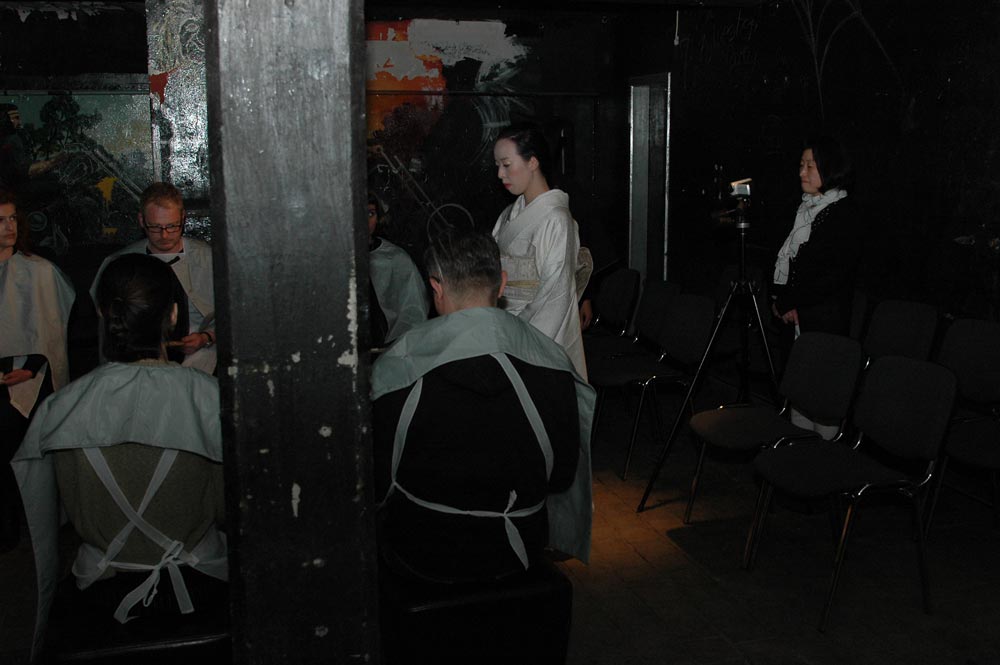
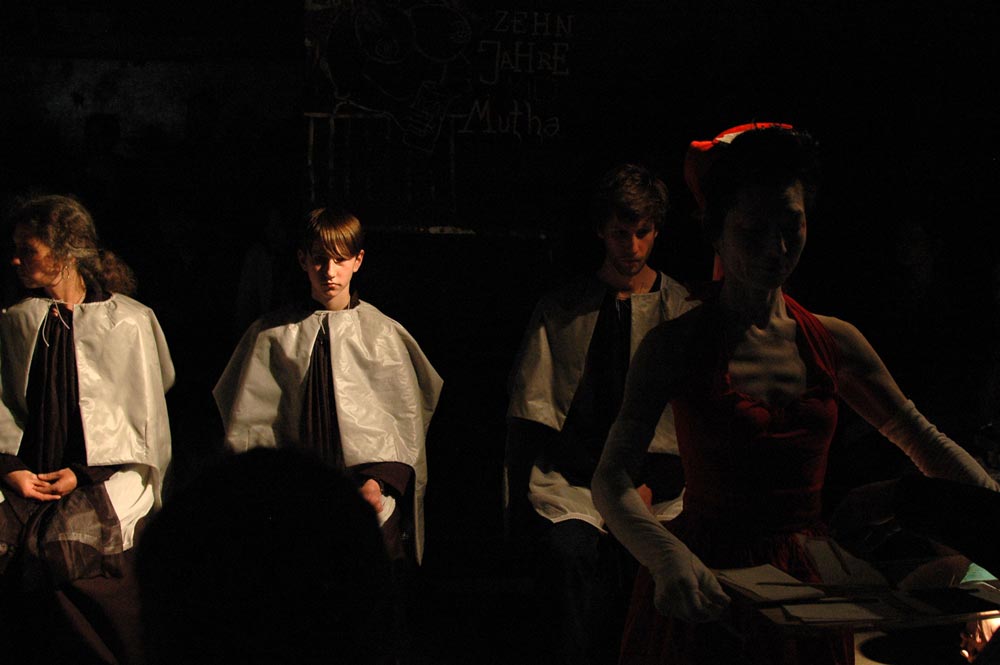
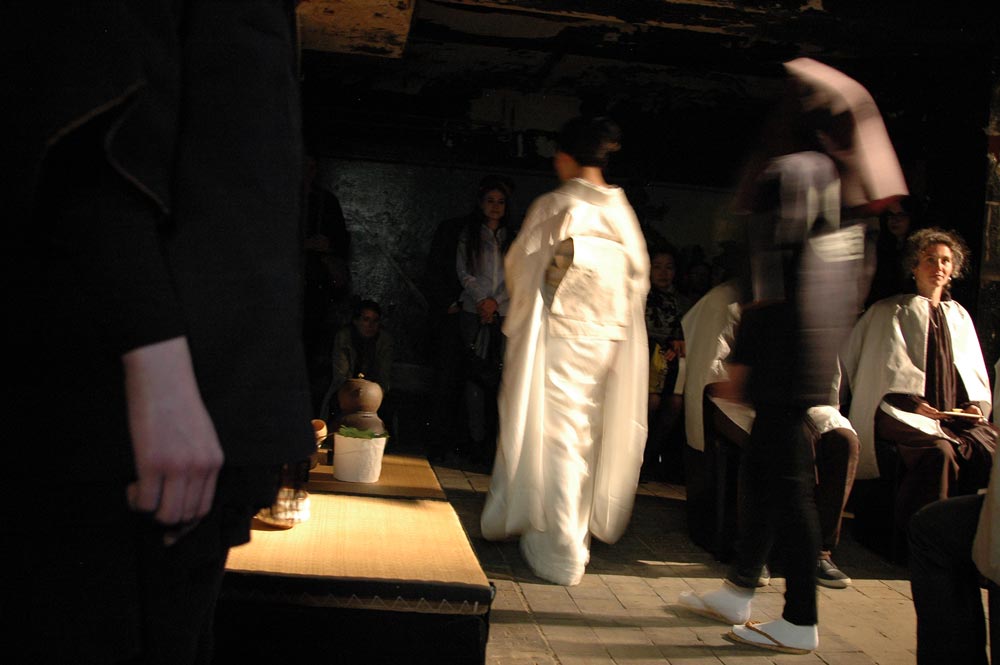
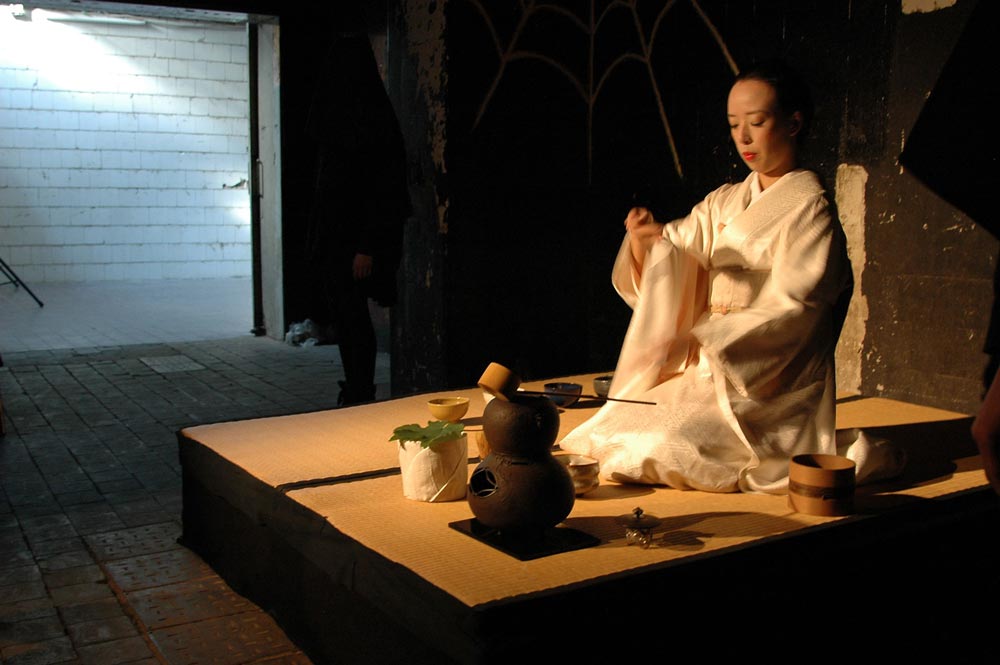
Transition from Arrival to Departure is conceived as a shared theatrical space, bringing together eight participants, the tea ceremony master, the dancer, and the public. The participants, gallery visitors selected at random by the dancer, were guided on a voyage through ritual actions, sound, movement, tea and condiments.
During this experience, participants assume the role of actors, observed by the surrounding audience while dressed in garments specially designed for the occasion by Margret Wibmer. The setting becomes a staged social environment shaped by principles rooted in Eastern philosophy, and may best be understood through Kitaro Nishida’s concept of “discontinuous continuity,” which describes the mutual interdependence of individuals. Yet this is not intended as a demonstration. Rather, it unfolds as a shared space, an encounter and meeting point for the exchange between Eastern and Western modes of thought.
In this performance at the Weltkunstzimmer, the counterpart to the tea ceremony master was the dancer Kiyomi Yamashita, who’s movement references Butoh dance. Yamashita plays a key role as a medium and connector between the tea ceremony master and the participants. Furthermore she represents what Nishida Kitaro calls ‘acting-intuition’. The process of communicative actions, which is not only lead by rational reasons.
Just like in the traditional tea ceremony where subtile sounds like the boiling of the water or the cracking of the fire and the charcoal play an important role, the soundscape of Minowa Norihito which is a metarmorphosis of sounds of metal, water and the human voice. Not heavily present but moving through space light as air. The composition is made according to the artistic concept and the specific architectural space, influencing the perception of all elements and actions in our event.
With this performance, we wish to provide an opportunity for a cross-cultural exchange based on historical relations and a critical discourse, with the intention to break with conventional forms of representation and cultural coding.

Concept: Akane Nakamori and Margret Wibmer / Dancer: Kiyomi Yamashita / Sound composition: Norihito Minowa / Sound technician: Norihiro Mori/ Costumes and photography: Margret Wibmer / Glass bowl: Masaki Kusada / Trays: Takuma Pottery / Original sweets: Yoshihashi, Kanazawa / Tea coordinator: Yoriko Nakagawa / Video: Shoko Takimoto and Kenichi Tani
Participants performance: Fuyuko Kobori, Yoshiaki Sakamoto, Hiroaki Ochiai, Megumi Takabatake, Yoko Ueda, Kjell Hahn. Participants rehersal: Daisuke Inoue, Ai Ikejiri, Eri Yamamoto, Syota Yamamoto, Dai Hijikata, Satomi Den. Participants rehearsal: Daisuke Inoue, Ai Ikejiri, Eri Yamamoto, Syota Yamamoto, Dai Hijikata, Satomi Den
Generously supported by: Komatsu Seiren CO.,Ltd., Kanazawa Bunka Fashion College: Hisae Hashimoto (tutor), Emi Fukaya (tutor), Kazuhiro Nomura, Yukiko Nishimura, Haruka Hori and Miyuu Yoshimura (students) and Mondriaan Foundation NL, The Austrian Federal Ministry for the Education, the Art and Culture, Land Tirol.
Transition from departure to arrival at Weltkunstzimmer in Düsseldorf: Concept: Akane Naka-Mori and Margret Wibmer; Project Coordinator and organisation: Margret Wibmer; Tea ceremony master: Fuyuko Kobori (Tokyo, JP)Dancer: Kiyomi Yamashita (Kanazawa, JP)Dance choreography: Akane Nakamori (Kanazawa, JP) Soundscape: Minowa Norihito (Kanazawa, JP)Costumes and photography: Margret Wibmer (Amsterdam, NL/AT) video: Shoko Takimoto (Tokyo, JP) 8 visitors as participants